
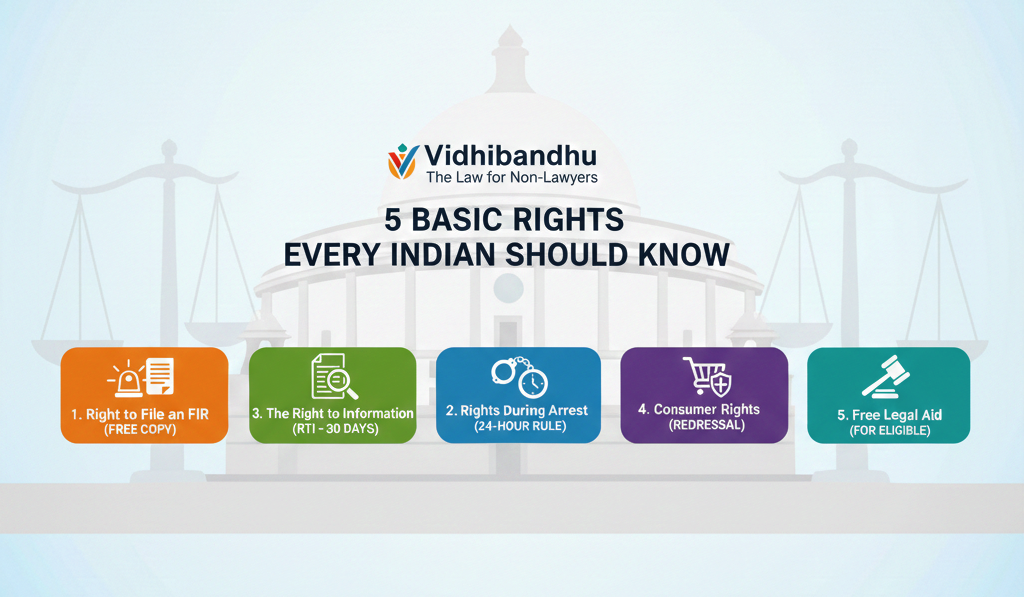
The Law for Non-Lawyers: 5 Basic Rights Every Indian Should Know. In India, we often hear the phrase “Kanoon sabke liye barabar hai” (The law is equal for everyone). But how can the law protect you if you don’t know what your protections are? At Vidhibandhu, we believe that legal literacy is the first step toward true citizenship.
You don’t need a law degree to protect your dignity. Here are 5 basic legal rights that every Indian should have at their fingertips.
- The Right to File an FIR (Free of Charge)
If a crime happens, your first point of contact is the police. Under Section 154 of the Criminal Procedure Code (now under the Bharatiya Nagarik Suraksha Sanhita), a police officer cannot refuse to file a First Information Report (FIR) if the information discloses a cognizable offence (serious crimes like theft, assault, or fraud).
Zero FIR: If a crime happens in a different area, you can still file an FIR at any police station. They are legally bound to accept it and later transfer it to the correct station.
Proof: You are entitled to a free copy of the FIR immediately after it is registered.
- Rights During Arrest (The 24-Hour Rule)
The fear of the “police station” often stems from not knowing your rights during detention. The Constitution of India (Article 22) provides a shield against arbitrary arrest:
The 24-Hour Limit: If the police arrest you, they must produce you before a Magistrate within 24 hours. This prevents illegal long-term detention.
Right to Know: You have the right to be informed of the grounds of your arrest at the very moment you are taken into custody.
Right to Silence: Under Article 20(3), no person can be compelled to be a witness against themselves. You have the right to remain silent to avoid self-incrimination.
- The Right to Information (RTI)
Think of the RTI Act (2005) as your “Public Audit” tool. It allows any citizen to ask for information from government departments.
Transparency: You can ask about the status of your passport application, why a road in your locality isn’t being fixed, or how much a government project actually costs.
Timeline: The government official (PIO) must respond within 30 days. If the information concerns a person’s life or liberty, they must reply within 48 hours.
- Consumer Rights: The Right to Redressal
Ever bought a defective phone or been overcharged at a restaurant? You aren’t helpless. The Consumer Protection Act empowers you to take action against unfair trade practices.
The Right to be Informed: Sellers must provide details on quality, quantity, and price (MRP).
Redressal: If a company ignores your complaint, you can approach the Consumer Forum. You don’t always need a lawyer for this; you can represent yourself or file a complaint online through the “E-Daakhil” portal.
- The Right to Free Legal Aid
Justice should not be a luxury reserved for the rich. Under Article 39A, the State is mandated to provide free legal services to ensure that opportunities for securing justice are not denied to any citizen by reason of economic or other disabilities.
Who is eligible? Women, children, SC/ST members, and people with low incomes are eligible for free legal services through the National Legal Services Authority (NALSA).
How to get help? You can visit the Legal Services Clinic in any court complex to request a free advocate for your case.
Conclusion
Knowing these five rights is like carrying a “legal shield” in your pocket. Laws are not just meant for courtrooms; they are tools for everyday life. At Vidhibandhu, we encourage you to stand up for yourself—because a citizen who knows the law is a citizen who cannot be exploited.